Propriétés de la transformée de Laplace
Fondamental : Conditions de Heaviside
Une fonction du temps f(t) vérifie les conditions de Heaviside si elle vérifie : \(f(0) = 0\), \(\dot f(0) = 0\), \(\ddot f(0) = 0\)... c'est à dire si les conditions initiales sont nulles et le système au repos pour \(t < 0\).
Attention : Produit
La transformée de Laplace d'un produit de fonctions n'est pas le produit des transformées ! Idem pour la transformée inverse.
Unicité
A \(f(t)\) correspond \(F(p)\) unique, et vice-versa.
Linéarité
Linéarité
\(\mathcal{L} \ \left[ f_1 (t) +f_2 (t)\right] = \mathcal{L} \ \left[ f_1 (t) \right] + \mathcal{L} \ \left[ f_2 (t) \right]\)
\(\mathcal{L} \ \left[ \lambda f(t) \right] = \lambda \ \mathcal{L} \left[ f(t) \right] = \lambda \ F(p)\)
Facteur d'échelle
Complément :
On cherche \(\mathcal{L}\left(f(at)\right)=\int_0^{\infty}e^{-pt}f(at)dt\).
En posant \(u=a\ t\) donc \(du=a\ dt\) on a \(\mathcal{L}\left(f(at)\right)=\int_0^{\infty}e^{-p\frac{u}{a}}f(u)\frac{du}{a}\)
Définition :
\(\mathcal{L}\left(f(at)\right)=\frac{1}{a}\ F\left(\frac{p}{a}\right)\)
Dérivation
Complément :
On recherche \(\mathcal{L}\left(\frac{df(t)}{dt}\right)=\int_{0}^{+ \infty} e^{-p\ t} \times \frac{df(t)}{dt} \ dt\)
On intègre par parties en posant \(u=e^{-pt}\) donc \(du=-p \ e^{-pt}\) et \(v=f(t)\) donc \(dv= \frac{df(t)}{dt}\).
D'où \(\mathcal{L}\left(\frac{df(t)}{dt}\right)=\left[e^{-pt} f(t)\right]_0^{\infty}-\int_0^{\infty}-p\ e^{-pt}\ f(t) \ dt\)
Or \(\lim\limits_{t\rightarrow \infty}e^{-pt}f(t)=0\) car \(f(t)\) est bornée : on obtient alors la propriété ci-dessous.
Définition :
Dérivée première : \(\mathcal{L} \left[ \frac{d f(t)}{dt}\right] = p \ F(p) - f(0^+)\)
Dérivée seconde : \(\mathcal{L} \left[ \frac{d^2 f(t)}{dt^2}\right] = p^2 \ F(p) - p \ f(0^+) - f'(0^+)\)
Fondamental :
Dans les conditions de Heaviside : \(\mathcal{L} \left[ \frac{d f(t)}{dt}\right] = p \ F(p)\) et \(\mathcal{L} \left[ \frac{d^2 f(t)}{dt^2}\right] = p^2 \ F(p)\)
Dériver par rapport à t dans le domaine temporel revient alors à multiplier par p dans le domaine symbolique.
Intégration
Complément :
On recherche \(\mathcal{L}\left(\int_0^tf(u)\ du\right)\).
Soit \(f(t)=\frac{d \ g(t)}{dt}\).
On a alors \(\mathcal{L}\left(f(t)\right)=F(p)=\mathcal{L}\left(\frac{dg(t)}{dt}\right)=p\ G(p) - g(0^+)=p\ \mathcal{L}\left(\int_0^tf(u)\ du\right)- g(0^+)\).
Définition :
\(\mathcal{L} \left[ \int_0^t f(u) \ du\right] = \frac{F(p)}{p} + \frac{g(0^+)}{p}\)
Fondamental :
Dans les conditions de Heaviside : \(\mathcal{L} \left[ \int_0^t f(u) \ du\right] = \frac{F(p)}{p}\)
Intégrer dans le domaine temporel revient à diviser par p dans le domaine symbolique.
Théorèmes
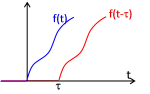
Fondamental : Théorème du retard
\(\mathcal{L} \left[ f(t-\tau)\right] = e^{- \tau p}\ F(p)\)
Fondamental : Théorème de la valeur initiale
\(\lim\limits_{t \to 0} f(t) = \lim\limits_{p \to \infty} p \ F(p)\)
Fondamental : Théorème de la valeur finale
\(\lim\limits_{t \to \infty} f(t) = \lim\limits_{p \to 0} p \ F(p)\)
Attention :
Ne pas oublier la multiplication par \(p\) dans le domaine symbolique !